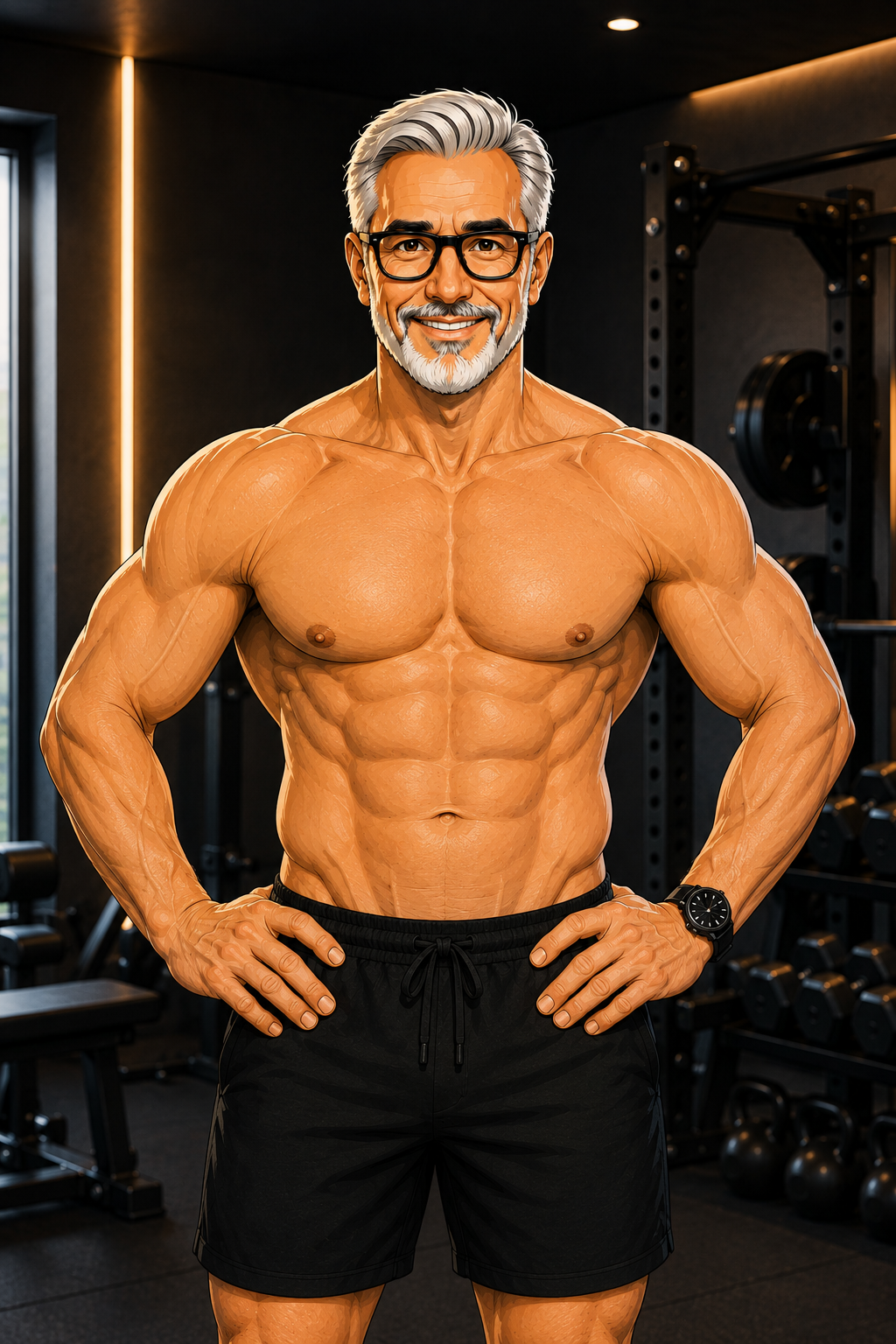
34 YEARS IN
CORPORATE.
18 MONTHS
REBUILDING.
This is the story of what stopped working at 60 — and what I found when I went looking for what actually did.
 Alex Hopper
Illustrated Brand Character
Alex Hopper
Illustrated Brand Character
WHY YOU SEE A CHARACTER,
NOT A CAMERA
You will notice that Alex Hopper is represented as an illustrated character — not a man on camera. That is a deliberate decision. I spent 34 years in senior corporate leadership. The professional world I came from is not one where a public fitness presence sits comfortably alongside an executive identity. The avatar is the boundary I chose between those two worlds. It is a privacy decision, not a credibility one.
What sits behind the avatar is real. The 18 months of research is real. The results on my own body are real. Every protocol on this channel was tested on a 62-year-old man — me — before it was published. Every claim is sourced. Every number is specific. I did not build this brand to sell unverified claims. I built it because I spent 34 years being professionally accountable for everything I said, and I apply exactly the same standard here.
The character is how I appear. The work behind it is mine.
— Alex
THE CAREER THAT TOOK EVERYTHING
I spent 34 years in corporate leadership. Long hours, constant travel, the kind of schedule that leaves you eating at airports and sleeping in hotel rooms more nights than you would like to admit. I am not complaining about that — I built something I am proud of and I would make the same choices again.
But I also trained throughout those 34 years. Not obsessively — I was never the man who missed a meeting to go to the gym. But consistently. Three, four times a week, depending on the travel schedule. I lifted weights. I did some cardio. I watched what I ate reasonably well.
I was fit by any reasonable standard for most of my 40s and most of my 50s. Not elite. Not magazine-cover. But lean, strong, and capable. I assumed that as long as I kept showing up, I would stay that way.
“I assumed that as long as I kept showing up, things would stay more or less the same. That assumption was the problem.”
WHEN EVERYTHING STOPPED WORKING
At 60, something changed. Not overnight — gradually, then all at once. The muscle I had maintained for two decades started disappearing despite consistent training. My energy, which had always been reliable, started failing me in the afternoon in a way it never had before. Recovery from training sessions that used to cost me nothing started taking days.
I trained harder. It made things worse. I ate cleaner. The muscle kept going. I added more cardio. My energy declined further. Everything I had always done — the exact same inputs that had always produced the exact same outputs — was producing nothing. Or worse than nothing.
My first assumption was that this was what ageing looked like. That somewhere between 58 and 62 the body simply stops cooperating and the best you can do is slow the decline. I heard this from other men my age. I read it in fitness articles that talked about “maintaining” rather than “building” after 60. The message was consistent: this is just what happens.
I did not accept it. Not because I was in denial about ageing — I was not. But because the decline felt too specific, too mechanical, too predictable to be random biology. Something specific had changed. And if something specific had changed, there was a specific reason. And if there was a specific reason, there was a specific response.
WHAT I FOUND IN THE RESEARCH
I spent 18 months going through the peer-reviewed literature on training, nutrition, and physiology in men over 60. Not fitness magazines. Not supplement company white papers. Actual research — journals like the Journal of Physiology, the British Journal of Nutrition, the Journal of Clinical Endocrinology and Metabolism.
What I found was both clarifying and infuriating. Clarifying because the biology was specific and well-documented. Infuriating because almost none of it was making its way into the fitness content being produced for men my age.
The core finding was this: four specific biological shifts occur after 60 that fundamentally change how the body responds to training and nutrition. Anabolic resistance — a measurable reduction in the muscle protein synthesis response to training and protein intake. Testosterone decline — not dramatic, but significant enough to change how the body recovers and builds. Reduced satellite cell activity — the mechanism by which muscle repairs itself slows substantially. And joint loading tolerance changes that make certain training patterns that worked at 40 actively counterproductive at 62.
The response to these changes is not to train harder or eat less. The response is to train differently, eat more specifically, and recover deliberately. Not the same programme with more effort applied. A different programme built for the biology that actually exists after 60.
“The men who stay strong after 60 are not the ones who train the hardest. They are the ones who finally stopped applying a 40-year-old’s logic to a 62-year-old’s body.”
I applied what I found to my own training and nutrition systematically over the following 12 months. Within four weeks the results were measurable. Within 12 weeks they were visible. Within a year I was building muscle at 62 at a rate I had not experienced since my late 40s. The afternoon energy that had been gone for two years came back — not from a supplement or a hormone prescription, but from three specific changes to how I structured my day.
WHY I BUILT THIS CHANNEL
I started talking about what I had found with other men my age — colleagues, friends, men I trained alongside. The pattern was identical in almost every conversation. The same results stopping around 60. The same confusion about why. The same resignation that this was simply ageing.
And the same absence of useful, specific information. The fitness industry has produced an enormous amount of content for men in their 30s and 40s. There is almost nothing built specifically for the biology of a man over 60 — not adapted from something written for a younger man and relabelled, but built from the ground up around what the evidence actually shows about this specific body at this specific age.
That gap is what this channel exists to fill. Every video, every guide, every piece of content on this channel is built on one standard: would this have helped me when I was standing in the gym at 60 watching everything I had built starting to disappear?
If the answer is yes, it goes on the channel. If it is generic, if it was written for a younger man, if it does not acknowledge the specific biological reality of being over 60 — it does not.
The Standard Every Piece Of Content Is Held To
- Built specifically for the biology of men over 60 — not adapted from content written for younger men
- Evidence-based — every recommendation is supported by peer-reviewed research, cited specifically
- Specific — every number is exact, every protocol is named, every dose is stated
- Honest about what the evidence supports and what it does not
- Written for men who respect their own intelligence and want to be treated accordingly
- Built by a man who has tested everything on his own body at the age he is talking about
- General fitness advice relabelled for older men
- Supplement promotion dressed up as education
- Motivational content without specific, actionable information underneath it
- Built around the idea that men over 60 should simply accept decline
- Written for an audience that wants to be told what they want to hear
- A replacement for medical advice — significant health decisions require a physician
Three Pillars. Every Video. Every Guide.
The specific training system for the body a man has after 60 — not the body he had at 40. What works, why it works, and the exact programme that produces results.
- The four biological shifts that change everything after 60
- The four compound movements that build every major muscle group
- Progressive loading after 60 — the right approach
- Training frequency, volume, and recovery windows
- The six most common training errors men over 60 make
The eating framework for muscle, energy, and body composition after 60. Specific targets. Named foods. Exact timing. No generic advice about eating more vegetables.
- Protein requirements — the specific numbers most men miss
- The daily meal structure and the reason for each choice
- What to stop eating and the mechanism behind each one
- The supplement protocol — three that work, five to stop buying
- Hydration and its specific effect on muscle retention
The three energy systems that determine how a man feels after 60 — and the specific morning, afternoon, and evening interventions that keep all three functioning.
- The cortisol awakening response and how to maximise it
- The three causes of afternoon energy loss — and three fixes
- The testosterone lifestyle factors with real evidence
- The sleep protocol specific to men over 60
- The evening protocol that determines tomorrow’s energy
“I did not build this channel because I had all the answers at 60.
I built it because I spent 18 months finding them —
and because no one should have to start that search from scratch.”
— Alex Hopper · alexhopper.co
THE BLUEPRINT
IS FREE.
Start with the Over-60 Muscle Blueprint. Five things. Seven pages. The foundation everything else on this channel is built on — delivered to your inbox immediately.
No spam. Unsubscribe any time.